
Timeline & Rules — COBRA
Cone-beam CT reconstruction for radiation therapy challenge: from projections to planning CT quality
The pre-print of the COBRA dataset paper will be released on arXiv concurrently with the challenge launch.
Competition Timeline
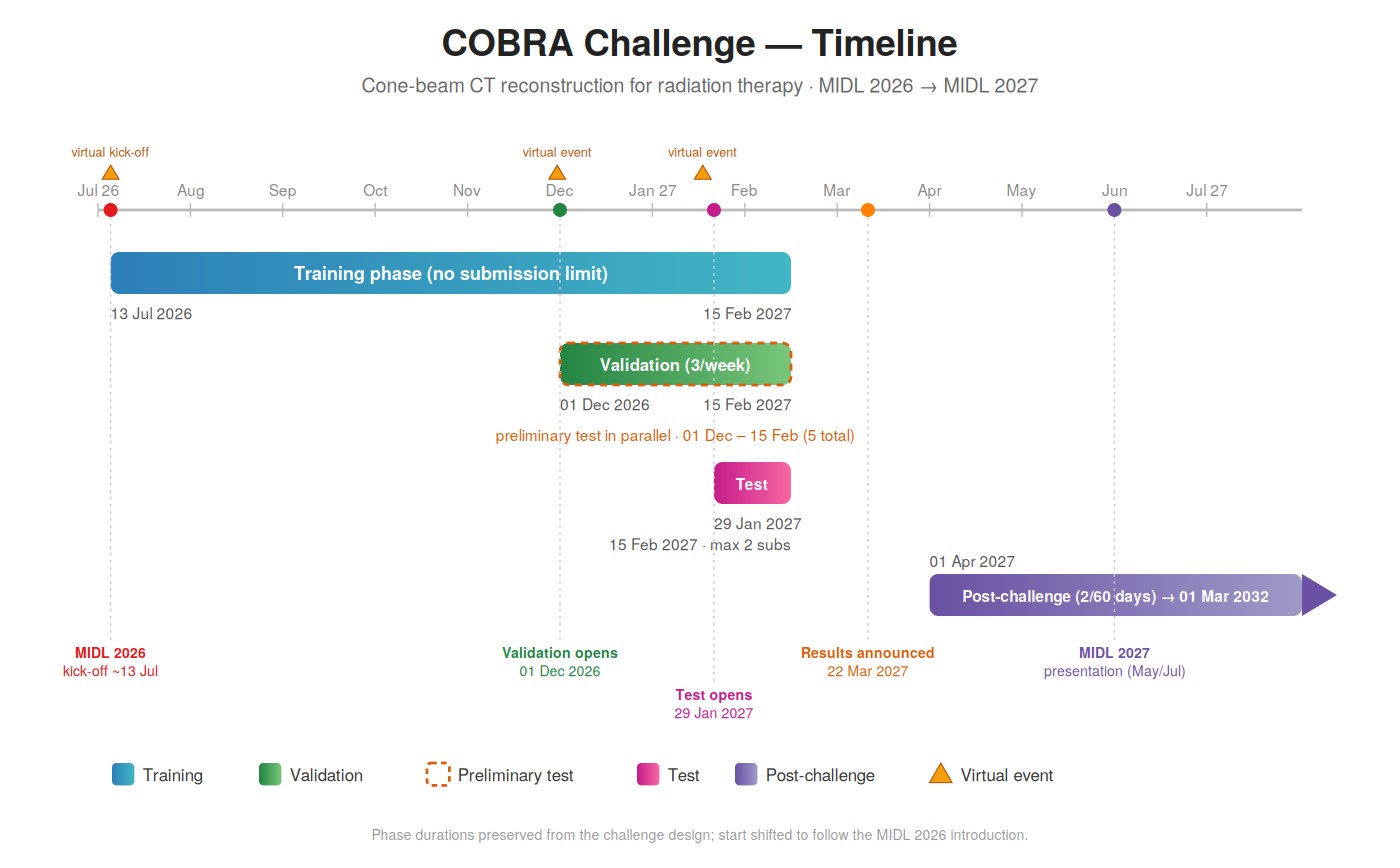
The challenge is introduced at MIDL 2026 and the training phase starts immediately afterwards. Each phase transition is accompanied by a virtual event in which the organizers present the design, dataset, rules, and answer questions. Phase durations follow the original challenge design; only the start date has been shifted to follow the MIDL 2026 introduction.
| Milestone | Date |
|---|---|
| Virtual kick-off event — design, dataset & rules explained at MIDL 2026 | ~13 Jul 2026 (postponed to 10 Aug 2026) |
| Challenge website opens, training cases released — training phase starts | 13 Jul 2026 |
| Training phase (no submission limit) | 13 Jul 2026 – 15 Feb 2027 |
| Virtual event — opening of the validation & preliminary test phases | ~30 Nov 2026 |
| Validation phase (up to 3 submissions/week) | 01 Dec 2026 – 15 Feb 2027 |
| Preliminary test phase (5 submissions total, in parallel with validation) | 01 Dec 2026 – 15 Feb 2027 |
| Virtual event — opening of the test phase | ~28 Jan 2027 |
| Test phase (dockerized algorithms, max 2 submissions) | 29 Jan 2027 – 15 Feb 2027 |
| Announcement of results and invitation to present | 22 Mar 2027 |
| Presentation of challenge results at MIDL 2027 | May / Jul 2027 |
| Post-challenge phase (max 2 submissions per 60 days) | 01 Apr 2027 – 01 Mar 2032 |
Rules
ENTRY INTO THIS CHALLENGE CONSTITUTES YOUR ACCEPTANCE OF THESE OFFICIAL RULES. Every participant must sign up for a verified Grand-Challenge account on www.grand-challenge.org and join the challenge to be able to submit.
Methods
Only fully automatic methods are allowed. Methods should be submitted as specified on the submission page. Algorithms must process projection data without manual intervention, behaving like a traditional reconstruction algorithm.
Inference should run on an AWS g4dn.2xlarge instance using a single GPU with 16 GB VRAM, 8 CPU cores, and 32 GB RAM. Participants have the possibility to select also only CPU or a smaller GPU. If you do not need the full VRAM, participants are encouraged to use the smaller variants to save cost.
Maximum inference time to produce a reconstruction for a single case (one patient) should be 20 min.
One account per participant/team
Each participant/team can only use one account to participate in the competition. Participants who use multiple accounts will be disqualified from the competition. Each team can be composed of five participants maximum. Once a participant or team submits, they cannot withdraw from the challenge.
Use of other training data / pre-trained models
Participants must train their algorithms exclusively using:
- The data provided by the challenge.
- Publicly available data that is accessible to all participants before the start of the training phase (13 July 2026). Any external data used must be clearly documented in the submission.
To ensure a fair evaluation, pre-trained models may be used for initialization or fine-tuning, provided that their weights are publicly accessible before 13 July 2026.
Specifically:
- ✅ Allowed: Using open-source codebases as a reference or for implementation.
- ✅ Allowed: Training a model from scratch using only the permitted datasets.
- ✅ Allowed: Initializing a model with pre-trained weights, as long as they were publicly available before 13 July 2026.
- ❌ Not Allowed: Fine-tuning a model trained on any private dataset or with private weights not publicly available by 13 July 2026.
- ❌ Not Allowed: Use of any external private CBCT data — strictly forbidden to ensure reproducibility and fair access for all participants.
Code of the submitted algorithm
The top three teams must disclose and openly share their code, weights, or models to allow for future re-use of their algorithms. The model can also be shared as a Docker version without sharing the code. While all other teams are strongly encouraged to do so, it is not mandatory. The code or Docker image should be provided within 14 days of the announcement of the winning participants.
Award eligibility
As a condition for being ranked and considered as a challenge winner or eligible for any prize, the teams/participants must fulfil the following obligations:
- Submit a paper reporting the details of the methods in a short or long LNCS format, following the checklist provided on the submission page. Organizers reserve the right to exclude submissions lacking any of the elements listed in the checklist.
- Submit the form reporting the algorithm's details after the test submission has been completed, as provided by the organizers.
- Sign and return all prize acceptance documents as may be required by the Competition Sponsor/Organizers.
- Commit to citing the data challenge paper and the data overview paper whenever submitting the developed method for scientific and non-scientific publications.
Awards
The results and winner will be announced publicly via the challenge website and shared via social media channels, and the top teams will be invited to present their approach during the final MIDL event.
Once participants submit their results via the challenge website, they will be considered fully vested in the challenge, so that their performance results will become part of presentations, publications, or subsequent analyses derived from the challenge at the discretion of the organization. Specifically, all the performance results will be made public.
Depending on the available funding, organizers reserve the possibility to award cash prizes to the top teams.
Participation policy for organizers' institutes
Members of the organizers' institutes may participate in the challenge but are not eligible for awards and will not be listed in the leaderboard.
No private sharing outside teams
Privately sharing code or data outside of teams is not permitted.
Submission
We run a type 2 challenge in which algorithm submissions are processed through the website during the test phase (see the Grand Challenge documentation). Validation uses type 1 submission (predictions uploaded after the algorithm is run). During the test phase, teams submit their dockerized reconstruction algorithms to the challenge website without access to the test data.
- Validation phase: up to 3 submissions per week; all validation submissions are visible on an open dashboard.
- Preliminary test phase (in parallel with validation): up to 5 submissions total, allowing teams to test their dockerized algorithms on a validation subset.
- Test phase: up to 2 submissions; only the last run counts toward the official ranking. Each run must include a description.
Warnings will be sent for incorrect submission formats or performance below a low threshold. Once the challenge is presented at MIDL, a post-challenge phase opens, making the validation and test phases available again.
Follow-up publication
The COBRA organizers will consolidate the results and submit a challenge paper to Medical Image Analysis or a similar venue. Each team ranked among the top three will be invited to participate in this publication and will be required to submit an algorithm summary in LNCS proceedings format. The organizers reserve the right to reduce the number of co-authors among the team participants to a minimum of two. The organizers will analyze their reconstructions, as the challenge submission system will have automatically solicited them.
Publishing the submitted method elsewhere
The organizers, contributors, and data providers can independently publish methods based on the challenge data after an embargo of 6 months from the challenge's final event. The embargo is counted from the final event, considering the submission date of the work. Participants can submit their results elsewhere after an embargo of 6 months; however, if they cite the overview paper, no embargo will be applied.
Other rules
Once a participant or a team submits, the submission or the team cannot be withdrawn from the challenge.
The remaining rules are provided along with the challenge design.
Evaluation code and pre-/post-processing code will be publicly available at github.com/cobra-challenge-2026.